


Often, a restaurant’s kitchen leaders are also its unsung heroes, toiling behind the scenes to provide a pleasurable dining experience for the eatery’s patrons. In this series, we shine a spotlight on talented, creative, and unique individuals who have become, or are becoming, the culinary superheroes of our city, and explore the paths they have taken to establish themselves as rising or recognized gastronomic stars.
In this chapter, we introduce you to Top Chef Season 13 winner Jeremy Ford.
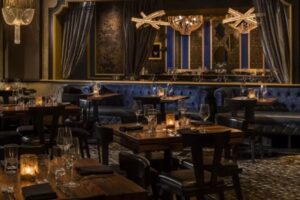
Chef Jeremy Ford is a renowned chef, best known for winning Bravo’s Top Chef Season 13, earning a James Beard semi-finalist nomination, and for his Michelin-starred restaurant, Stubborn Seed, in Miami Beach, Florida. Now he is sharing his talents and creativity with Las Vegas, as he has opened a second location of Stubborn Seed at Resorts World.


What made you decide to become a chef? How old were you, and how did you make that happen?
I grew up in Jacksonville, Florida. At a young age, when most kids were watching Barney, I was watching cooking shows like Galloping Gourmet and Emeril Live and saw cooking to be more fun than work. About the time I was 12 or 13, my mom, who was adopted as a baby, found her maternal grandmother, and we went out to the West Coast to meet her. She was an Italian woman, and when we met, she was making this beautiful roast, so we met over food, and that was a game-changer. I kept cooking and knew I wanted to do fine dining. At the age of 15, I started applying for jobs, but no one would hire me because I was too young. So, my father helped me create a fake ID, [claiming] I was 17, which shows how supportive my family was.
What were some of your first jobs in the culinary field? Who were some of your early mentors that you learned the most from?
My first job was at Matthew’s Restaurant, the only tasting menu-forward restaurant in the entire city (Jacksonville) at that time, so getting a position there was pretty miraculous. I did prep work and learned important fundamental techniques, all the things you would learn in culinary school, but in a fast-tracked version. It was the most important job of my career as it defined what I was looking for, and I learned so much from Mathew Medure (the restaurant owner/chef).

Mathew recommended that I go to New York to further my career, so I did, and I was lucky enough to get a position at L’Orangerie, a Michelin-starred high-level French restaurant in NYC, under the direction of Christophe Eme. There, I learned how to cook fish properly and all the other techniques one would expect at a high-level French restaurant. I also worked at several of Jean-Georges Vongerichten’s New York restaurants and served as the opening executive chef at his Matador Room in Miami. After working as an executive chef there for four to five years, my next big move was to go on Top Chef. After I won, I got offers coming left and right to do new concepts and (in 2017) opened Stubborn Seed in Miami, which won a Michelin Star, and we’ve kept it three years running. It’s been an incredible eight-year run.
Why did you name your restaurant Stubborn Seed?
Naming a restaurant is one of the most difficult things. I chose the name because a stubborn seed is one that is the hardest to propagate and grow, but ends up being the best. It checks off boxes for us because we’re also stubborn about our ingredients and emphasize sustainability and using locally sourced ingredients.


What are some of your favorite cuisines to cook?
I can’t identify just one. Stubborn Seed is a very world-flavored type of restaurant. We use South African spices, Mexican dried chilis, and might go super Italian, but lean more into Japanese ingredients cooked with American technique.
What are some of your favorite dishes currently on your menu at the Las Vegas Stubborn Seed?
Right now in Vegas, we’re serving the Szechuan and coriander-cured Hamachi, which is accompanied by a buttermilk and passionfruit emulsion, as well as compressed Asian pear and fermented chilies. When you bite into it, you get creamy, spicy, soft, silky, lots of texture and pops and a wow factor moment, a celebration of acid and creaminess and all the senses that make an exciting meal. Also, roasted barramundi with a half-Thai, half-Indian curry, served with whatever vegetables are in season.
How do you develop your recipes?
We have a team of great chefs. We practice new recipes and challenge ourselves and are always thinking about what’s in season, and how we manipulate it to make it its true best form.
You’ve garnered some impressive awards and accomplishments, including winning Bravo’s Top Chef Season 13, earning a Michelin star, and being a James Beard Award semi-finalist. What are some of your other accomplishments, and which are you most proud of?
Getting the Michelin Green Star (for leadership in environmental sustainability) this year was a huge moment. I spent all my life savings to buy a six-acre farm in the southland of Miami, Florida. We’re composting all of our food waste, and we worked so hard and really showed what can happen when a team comes together and there’s an initiative.
Why did you choose to open a Stubborn Seed in Las Vegas at Resorts World?
It has been a dream of mine to be closer to the West Coast and have access to Hawaiian fish being flown in. The owners (of Resorts World) had dinner at Stubborn Seed in Miami, really loved the concept, and offered me the opportunity. After coming out here, chefs like Brian Howard and James Trees were so welcoming, which is a breath of fresh air.

How often do you come to Las Vegas?
I’m out there twice a month, and unless I’m doing a new opening, that’s how it will be forever. I’m not one of those chefs who throw their name on it and see you in six months kind of thing. I always book my flights one way because every time I go, I plan to stay five to seven days, but usually extend my stay.
What do you think of the Las Vegas culinary scene?
I think it’s incredible. It’s just a matter of time till Michelin Stars come. And it’s a myth that there’s no fresh fish here. I went to Chinatown and had the best fresh fish, which was even better than what you can get in Japan.
What do you like to do in your downtime, when you’re not working?
I love spending time on my farm, getting my hands in the soil. There’s something special about being out here. I also enjoy working out and have been practicing jujitsu since I was 20. I hope to get my black belt this year.
Any new restaurants planned?
Working on a tasting menu restaurant in Aruba called Terra, and one in Columbus, Ohio (no name yet), opening in less than a year.